

In this article
It may sound simple, but there is a surprising link between the way you breathe and your back pain.
Each breath can either contribute to spinal strain or help build a foundation of deep core stability that supports your spine. If you are looking for new strategies to manage back pain, understanding your breathing pattern can be an important component of your overall approach.
This guide explains the connection between your diaphragm and your lumbar spine. We will walk you through step-by-step breathing exercises designed to help release muscle tension, manage pressure on your spine, and support your comfort.
Try a simple back-opening breathing exercise
Start by taking a couple of deep breaths. Where does the air sit – can you feel it filling out your belly? If you can, or your lower belly sticks out when you inhale, you could be breathing incorrectly. A simple exercise in back-opening breathing will help you improve your posture and reduce back pain.
Find a comfortable position. You can practice this technique in any position, but it’s important to make sure your weight feels evenly distributed. Sitting upright (without over-extending your posture) is often an easy place to start.
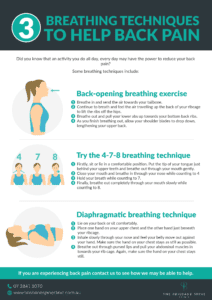
- Breathe in and send the air towards your tailbone.
- Continue to breath and feel the air traveling up the back of your ribcage to lift the ribs off the hips.
- Breathe out and pull your lower abs up towards your bottom back ribs.
- As you finish breathing out, allow your shoulder blades to drop down, lengthening your upper back.
Try the 4-7-8 breathing technique
- Firstly, sit or lie in a comfortable position. Put the tip of your tongue just behind your upper teeth and breathe out through your mouth gently.
- Close your mouth and breathe in through your nose while counting to 4.
- Hold your breath while counting to 7.
- Finally, breathe out completely through your mouth slowly while counting to 8.
Master the Foundation: Diaphragmatic Breathing (Belly Breathing)
If you learn only one technique, this is a great place to start. Many people with back pain tend to be “chest breathers,” using neck and shoulder muscles instead of their primary breathing muscle: the diaphragm. This can create upper body tension and leave the deep core muscles that support the spine underutilised. Diaphragmatic breathing helps to reactivate your core, encouraging a natural corset of support from the inside out.
How It May Help:
Your diaphragm attaches to your lumbar vertebrae. A proper diaphragmatic breath can create gentle pressure (intra-abdominal pressure) which is understood to help stabilize the spine, similar in principle to a weightlifter’s belt. This may help reduce the load on your spinal discs and surrounding back muscles.
How to Perform It:
- Get Comfortable: Lie on your back with your knees bent and feet flat on the floor. If this is uncomfortable, sit upright in a chair with your spine in a neutral position.
- Hand Placement: Place one hand on your upper chest and the other on your belly, just below your ribcage.
- Inhale Through Your Nose: Breathe in slowly and deeply through your nose for a count of four. Focus on sending the air down toward your belly. The hand on your belly should rise, while the hand on your chest remains as still as possible.
- Exhale Through Your Mouth: Purse your lips and exhale slowly for a count of six, gently engaging your abdominal muscles to press the air out. The hand on your belly should lower.
- Repeat: Continue for 5-10 minutes, focusing on the slow, rhythmic movement of your belly.
If you’re curious to learn more about breathing technique to manage back pain, it’s important to speak to a physiotherapist. A physiotherapist or spinal consultant can help you find the true cause of your back pain and work with you to develop a tailored plan to get relief from the pain.
“Breathing techniques is one of the many contributors to chronic back pain that usually goes unrecognised and untreated. We particularly see patients with respiratory conditions such as COPD, asthma, or if issues such as anxiety, stress, sleep apnea, having an altered breathing pattern. It is crucial that our breathing pattern is efficient and effective to ensure the best function of our core stability and contribute to the improvement of back pain.”
Mr Gun (Kevin) Kang, Physiotherapist of The Brisbane Spine Clinic.
Breathing Helps, But When Could Back Pain Be a More Serious Problem?
While breathing exercises can be a safe and useful tool for managing common back pain, it is crucial to recognise when your symptoms may require medical attention. This information is not a substitute for a professional consultation and diagnosis.
Seek advice from a doctor or physiotherapist if your back pain is accompanied by any of the following “red flag” symptoms:
- Loss of bladder or bowel control.
- Numbness, tingling, or weakness in your legs, groin, or rectal area.
- Fever, chills, or unexplained weight loss.
- Pain that is severe, constant, and progressively worsening, especially at night.
- Pain resulting from a significant trauma, such as a fall or car accident.
A qualified physiotherapist can conduct a thorough assessment to help identify the source of your pain – whether it’s muscular, disc-related, or something else – and develop a treatment plan tailored to your needs.
If you’re looking for a physiotherapist at Eight Mile Plains or North Lakes, call us on 07 3841 3070 or book an appointment online with Mr Gun (Kevin) Kang to learn more today.
Frequently Asked Questions About Back Pain & Management
Q: Do breathing exercises really help with back pain?
A: Yes, for many people, proper breathing can be a helpful tool for managing back pain. It works by engaging deep core muscles which help stabilise and support the spine. It can also assist in releasing tension in overworked back muscles and may help reduce the body’s overall stress response, which can be a contributor to chronic pain.
Q: How can I help manage back pain at home?
A: For managing general back pain at home, a combination of gentle movement, targeted techniques, and calming the nervous system can be an effective approach. Try gentle walking, applying a heat pack for 15-20 minutes to help relax muscles, and practising the diaphragmatic breathing technique described above to assist with tension.
Q: What are the “Big 3” exercises for lower back pain?
A: The “Big 3” are a set of core stability exercises developed by spine expert Dr. Stuart McGill. They are designed to build endurance in the muscles that support the spine without placing a harmful load on it. They include the Curl-Up, the Side Bridge (or Side Plank), and the Bird-Dog.
Q: Should you rest or stretch lower back pain?
A: The answer is nuanced: avoid complete bed rest, as it can make stiffness worse. Gentle movement like walking is highly recommended. For stretching, focus on gentle, pain-free movements. Avoid aggressive stretching, especially if the injury is acute, as it can sometimes worsen the problem. A physiotherapist can show you appropriate stretches for your specific condition.
Q: How can you tell if back pain is muscle or disc related?
A: While only a health professional can provide a diagnosis after an assessment, there are general indicators. Muscular pain often feels like a dull, aching soreness and is tender to the touch. Disc-related pain is often described as sharper, can have an “electric” sensation, and may radiate down your leg (sciatica).
Q: How do I know when my back pain might be serious?
A: You should see a doctor or physiotherapist if your back pain is accompanied by “red flag” symptoms such as loss of bladder/bowel control, numbness or weakness in your legs, fever, or if it follows a major injury. Constant, severe pain that doesn’t improve with rest also warrants a professional evaluation.
Q: What does a physiotherapist do for back pain?
A: A physiotherapist will first perform a thorough assessment to help identify the source of your pain. Treatment is a multi-faceted approach that can include creating a personalised exercise program to build strength and flexibility, performing manual therapy (like massage or joint mobilisation) to help relieve pain and stiffness, and educating you on posture and movement to help you manage your condition and reduce the risk of future episodes.
Disclaimer
All information is general and not intended as a substitute for professional advice. The Brisbane Spine Clinic can consult with you regarding your individual health needs.


